Worst case scenarios

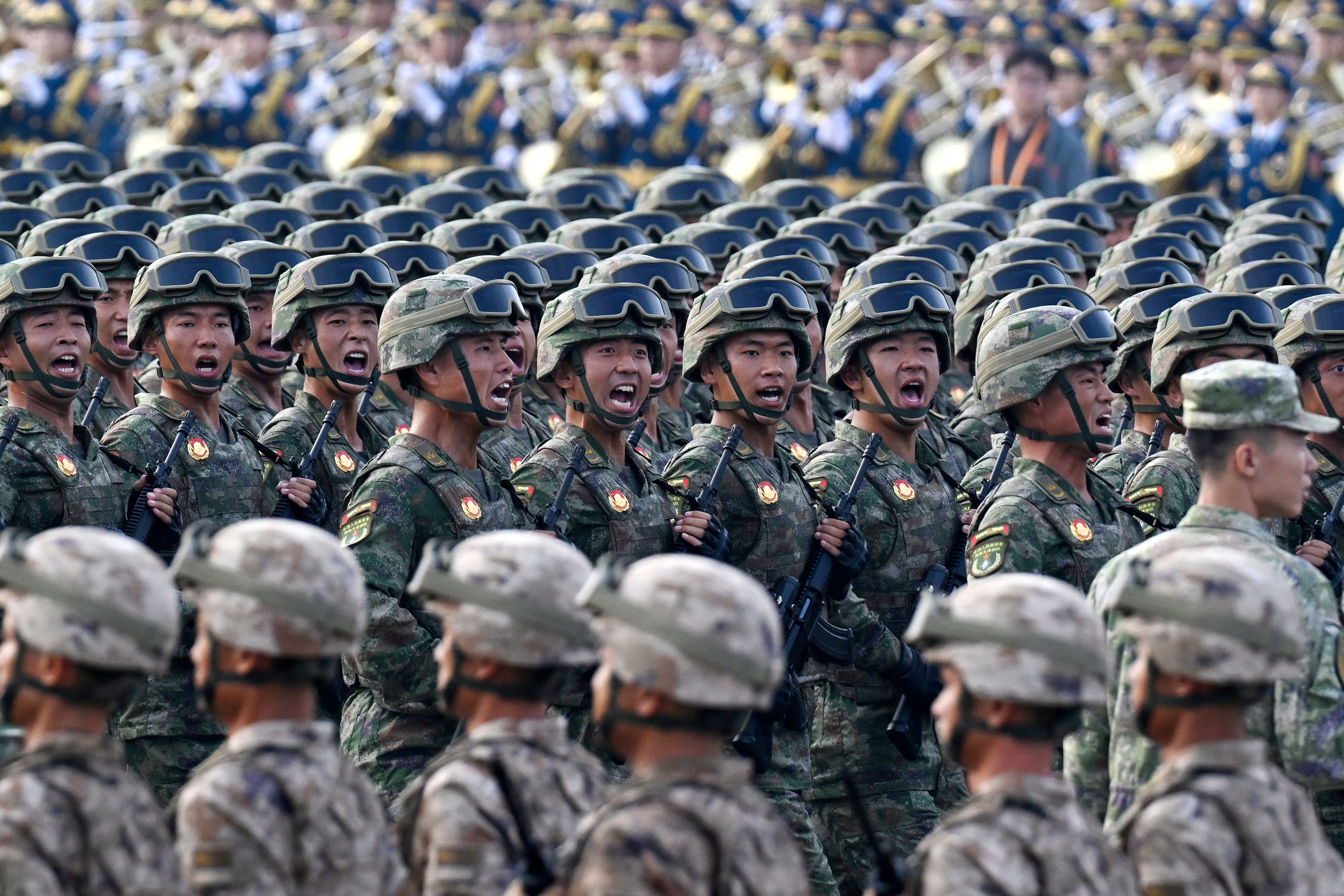
Soldiers of the Chinese PLA

China’s defence and security engagement in the Indo-Pacific has so far focused on the accumulation of presence and influence without overt confrontation. But establishing a permanent or semi-permanent base in the South-West Pacific or Indian Ocean would represent a significant escalation in its ability to project both hard and soft power. While such bases are not inevitable, their potential strategic implications are profound.

A base in the Solomon Islands, Sri Lanka, or another strategically located state would give China a platform to extend its naval, air, and logistical reach far beyond what is currently achievable. It would allow Chinese forces to operate closer to Australia’s maritime approaches, the broader South-West Pacific, and key shipping lanes in the Indian Ocean. The presence of a base would also create precedent, encouraging China to seek multiple access points or facilities across the region. Further impacts include:

Enhanced power projection  

A base could support longer-duration naval patrols, forward-deployed ships or submarines, and rapid replenishment of surface vessels. It could also support Chinese air operations, maritime surveillance and intelligence collection increasing the tempo and reach of China’s grey-zone and coercive operations.

The scope of a base could range from a logistics hub to a full military installation similar to China’s facility in Djibouti. Critically, such bases would allow blue-water naval operations to become persistent rather than periodic. Access to ports and airfields would provide logistical depth and redundancy, giving China a reason to deploy more military and security assets to the region. In the long term, these facilities would expand China’s capacity to project both hard and soft power across the South-West Pacific, Indian Ocean, and around Australia.

Information advantage and pre-positioning

Beyond physical presence, overseas bases would enhance China’s information and decision-making advantage. Continuous access to regional operational environments improves intelligence collection, situational awareness, and operational planning. Pre-positioned materiel and infrastructure enable rapid expansion of operations in response to crises, ranging from natural disasters to regional conflicts.

Even absent conflict or crises, the presence of a base would China operating military assets far closer to home than ever before. Regional countries would be required to significantly adjust their military posture and planning. A costly endeavor for any state.

Psychological impact

Bases carry a powerful psychological and signalling effect. Chinese basing in proximate locations would increase fear and influence domestic debates. It reinforce perceptions that any confrontation with China would carry significant cost. This would increase pressure on states to prioritise economic engagement rather than contest Beijing’s challenge to the regional order.

This dynamic could also create tension within regional alliances and frameworks. Divergent national priorities (economic versus security) may weaken collective responses and gradually fragment regional security arrangements even without overt coercion.

Challenging regional rules and norms

A base would also expand China’s ability to shape regional rules, norms, and institutions over time. Operating from abroad would allow China to more actively challenge existing maritime rules and freedom of navigation principles, a pattern already evident in the East and South China Seas.

Gradually, such operations could normalise activities previously viewed as provocative, providing China with both leverage and legitimacy for more assertive actions that advance its strategic interests.

Implications during crisis and conflict

A fully operational base represents a force multiplier in the event of a regional crisis or conflict. Chinese naval, air, and potentially space assets could be deployed in advance, enabling options for coercion, surveillance, and rapid escalation that were previously unavailable. For countries like Australia, this compresses response timelines and necessitates fundamental adjustments to force posture, including forward presence, surveillance, and defence planning.

The presence of a base would also exert strategic pressure, discouraging involvement in conflicts or constraining options for hosting allied forces. Finally the combination of forward basing, pre-positioned assets, and higher-tempo operations amplifies risks of miscalculation or unintended escalation, while providing China a strategic lever to influence regional decision-making even absent conflict.

Managing risk

The presence of US regional bases or rotational deployments is not an equal comparison of what countries could expect from a permanent Chinese presence. As Pressure Points highlights, Beijing’s strategic behaviour and intent differ fundamentally from that of the United States and China's use of military coercion against smaller states should serve as a cautionary tale for the broader Indo-Pacific.

While contesting overseas access is costly, the potential consequences of a permanent Chinese facility are far greater. China’s approach to securing a permanent presence is cumulative: it seeks to shape regional norms, build presence, and apply sustained pressure. These dynamics are difficult to counter effectively, both individually and collectively. This amplifies the importance of forward planning, intelligence collection, and coordinated action among regional partners.

Overseas bases are not inevitable, but their potential implications underscore the strategic stakes of China’s gradual expansion. Even a single installation could profoundly affect regional security, operational planning, and strategic posture.

China’s excessive claims and sensitive areas