Implications of China’s expanding presence

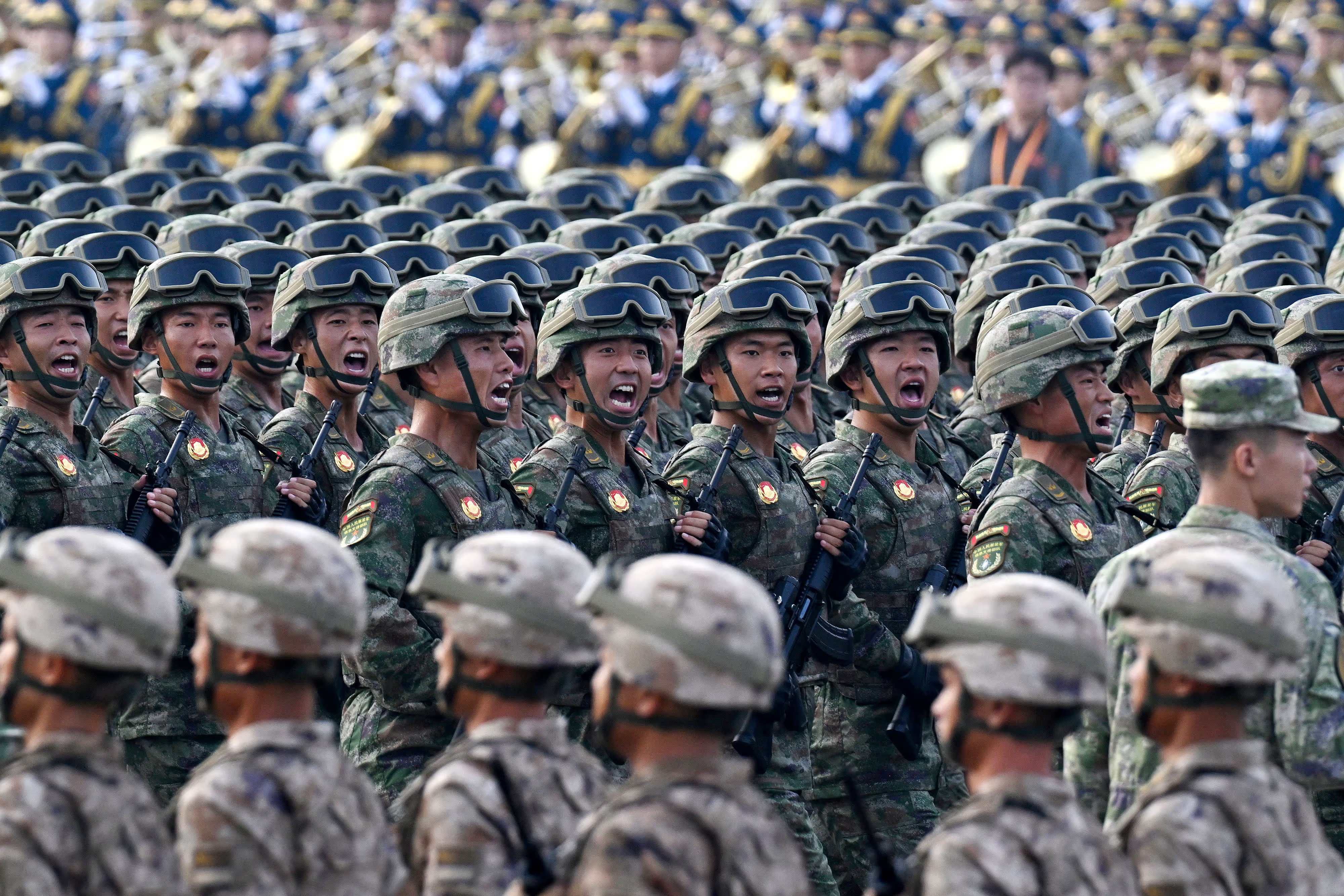
Soldiers of the Chinese PLA

China’s expanding defence and security engagement beyond the first island chain is not defined by abrupt shifts or overt confrontation. Its significance lies instead in the steady accumulation of presence and access across the South-West Pacific, Australia’s maritime approaches and the Indian Ocean. Over time, this accumulation will continue to reshape the strategic environment in ways that are difficult to reverse.

This approach reflects a broader strategic objective: to weaken the position of the United States and its partners, and to shape a regional order that is more accommodating of China’s interests. Defence and security engagement is a central instrument in this effort. It is used to build access, apply pressure and, over time, shape the rules, norms and behaviours that govern regional security. Several important implications stand out:

A more persistent and contested operating environment

Across all three regions, Chinese activity is becoming more regular, more capable and more geographically distributed. Naval task groups, Coast Guard vessels, research platforms and maritime militia assets are increasingly operating alongside regional and partner forces.

The result is a denser operating environment. Encounters that were once rare are becoming routine. Surveillance, shadowing and signalling activities are no longer exceptional, but are becoming part of the baseline. This reduces warning time, increases the complexity of day-to-day operations and raises the risk of miscalculation.

Shifting norms through grey zone actions  

China’s approach relies on operating below the threshold of conflict. Activities such as seabed mapping, intelligence collection and live-fire exercises are lawful, but strategically purposeful. Individually, they are difficult to contest. Collectively, they normalise China’s presence, help build Beijing’s understanding and seek to shape regional environments. Over time, they also raise the threshold for response, as actions that might once have triggered concern risk becoming accepted as routine. Such activities place pressure on military readiness and stretches the ability of states to respond.

China's approach to grey zone is not unconstrained. Where shaping activities are resisted or prove insufficient, they can be reinforced by more overt demonstrations of hard power. China’s behaviour around Taiwan and in the South China Sea illustrates how pressure can intensify, from persistent grey zone activity to more coercive military actions. These dynamics offer a warning for regions further afield, and underscore how China’s actions seek to gradually reshape regional rules and norms in ways that favour its interests.

Erosion of geographic advantage

Australia and the South-West Pacific have long benefited from distance as a strategic buffer. China’s expanding military and security presence is eroding this advantage. More frequent naval deployments and increased submarine activity beyond Southeast Asia, combined with persistent surveillance of maritime approaches, will reduce the protective effect of geography. China’s emergence as a capable blue-water navy enables it to project power into areas that were previously beyond its sustained reach.

This presence carries a psychological dimension. Chinese live-fire exercises and visible operations around Australia signal both capability and intent, shaping perceptions of regional power and creating a sense of proximity that did not previously exist. They are designed in part to influence domestic debates, pressing countries to weigh economic engagement with Beijing against resisting its regional advances. Diverging approaches to managing China can complicate coordination among allies partners, contributing to the fragmentation of collective regional security responses.

Greater pressure on regional states

Pacific Island and Indian Ocean countries are central to this evolving environment. China’s engagement offers economic and security benefits but also introduces new strategic pressures. Many regional states will continue to hedge, seeking to maximise opportunity while avoiding alignment.

However, as Chinese presence deepens, the space for manoeuvre will narrow. The risk is not uniform alignment, but possible fragmentation, as states adopt diverging approaches to external partners and security relationships.

A long-term strategic shift

Taken together, these trends point to a gradual but consequential shift. China is not seeking immediate dominance across the Indo-Pacific. It is shaping the environment so that its presence is normal, its access is expected, and its influence is embedded. This is strategic competition measured in years, not moments.

Its effect is unlikely to be defined by a single crisis, but by the steady reconfiguration of regional security dynamics, and by the progressive adjustment of rules, norms and behaviours in ways that advantage China over time.

China’s excessive claims and sensitive areas