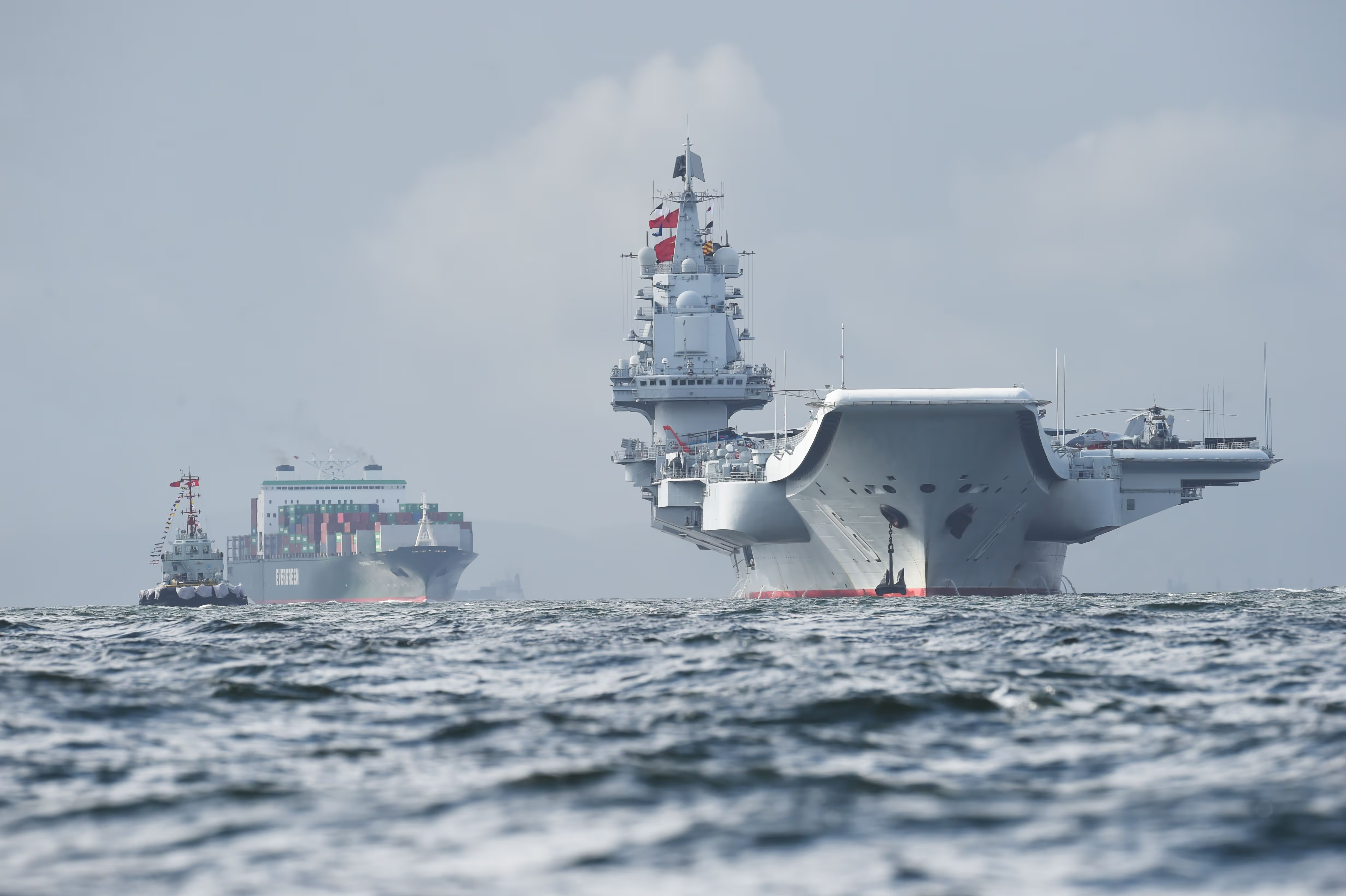
Before Xi Jinping, China’s military diplomacy focused on confidence-building, limited training and narrowly defined missions such as peacekeeping and counter-piracy, aimed largely at reassurance and integration into existing security frameworks. Under Xi, however, China’s defence and security posture has shifted towards an assertive posture that has sought to expand China’s global presence, protect overseas interests and engage in norm-shaping behaviour. That evolution reflects Xi’s attempts to remould the international system and is codified in the following strategic documents.
3.1.2
China’s security ambitions under President Xi

China’s Military Strategy (2015 Defence White Paper)
The 2015 Defence White Paper marked a foundational shift in PLA strategy by explicitly authorising a broader international security role. Its central theme—safeguarding China’s maritime rights and interests—elevated maritime power from a supporting function to a strategic priority. Most significantly, it introduced a new strategic task: safeguarding the security of China’s overseas interests, formally legitimising overseas operations in support of trade, citizens (Beijing includes overseas Chinese communities in its definition, even when they’re foreign citizens), and projects such as the Belt and Road Initiative.
The document directed the PLAN to move from ‘offshore waters defence’ towards a combination of offshore defence and ‘open seas protection’, signalling ambition for a bluewater navy capable of sustained global operations. It also called for expanded participation in international security cooperation and UN peacekeeping and deeper military relationships across regions. This white paper provided the intellectual and operational foundation for China’s expanding naval deployments, overseas logistics and growing defence engagement footprint.
China’s National Defense in the New Era (2019 Defence White Paper)
The 2019 Defence White Paper was a comprehensive document that explicitly tied PLA modernisation to intensifying strategic competition with the US. Unlike earlier white papers that focused on China’s ‘peaceful development’, this document detailed real capabilities, operational readiness and war-fighting preparation, especially in the Western Pacific and South China Sea. It also framed overseas instability, terrorism, piracy and threats to sea lines of communication as direct security challenges to China.
The white paper normalised the PLA’s global role. It openly discussed building ‘far seas forces’, developing overseas logistical facilities and conducting operations such as evacuations, vessel protection and maritime rights enforcement. It also highlighted the scale of China’s expanding defence diplomacy, including military exchanges with over 150 countries. Normatively, the white paper linked China’s military development to the creation of a ‘community of common destiny’ and called for a more ‘inclusive’ security architecture. This marked the PLA’s transition from a force preparing for global contingencies to one actively shaping international security environments.
Global Security Initiative (2022 Global Initiative)
Xi Jinping’s Global Security Initiative (GSI) offered a new vision for global security. It opposed alliances and sanctions and argued for respect for sovereignty and non-interference. Its appeal, particularly to the developing countries of the Global South, lay in its focus on regime stability, non-traditional threats and development-linked security, even as there is a significant gap between China’s rhetoric and its actions.
The GSI effectively rebranded China’s existing overseas defence and security activities. It provided a unified narrative for military diplomacy, policing cooperation, cybersecurity, counterterrorism and law-enforcement engagement. At the same time, it expanded the definition of security to reflect Beijing's priorities at home, encompassing economics, technology, data and overseas interests.
While presented as inclusive and cooperative, the GSI was a power play that implicitly privileged China’s interpretation of 'legitimate security interests', positioning Beijing as both a security provider and a normative competitor to US-led frameworks.
China’s National Security in the New Era (2025 National Security White Paper)
The 2025 white paper represents the most comprehensive articulation of China’s security vision to date. Unlike the military-focused 2019 document, it adopts a whole-of-society approach, integrating political control, economic resilience, technology, culture and overseas interests into a single, party-led security system. The PLA is no longer treated as a stand-alone institution but as one component of a broader national-security architecture.
It frames global instability, ‘hegemonism’, and ‘Cold War mentality’ as systemic threats while positioning China’s rise as historically inevitable and stabilising. It extends security concerns into new domains, including outer space, polar regions, the deep sea and emerging technologies. Targeted at both domestic and international audiences, the document calls on other states to align with China’s vision of order, reinforcing Beijing’s intent to lead, shape norms, and place its interests at the centre of international security arrangements.
These four documents demonstrate how China’s defence and security engagement has evolved under Xi Jinping, from enabling overseas operations to proposing an alternative global security order. However, it must be noted that, while China has released a few documents over the years that signal its strategic intent, much of its posturing is informed by non-transparent internal decision-making processes, which are highly centralised in Xi. For instance, the PLA’s behaviour in risky and dangerous encounters at sea and in the air against legal transits aren’t codified in any public-facing document. The PLA is through-and-through the CCP’s army. The PLA’s expanding power projection, deeper security partnerships and efforts to play a growing role in norm-setting (with mixed success) reflect a deliberate strategy to reshape international security practices in ways that prioritise the CCP’s interests while challenging Western-led systems.