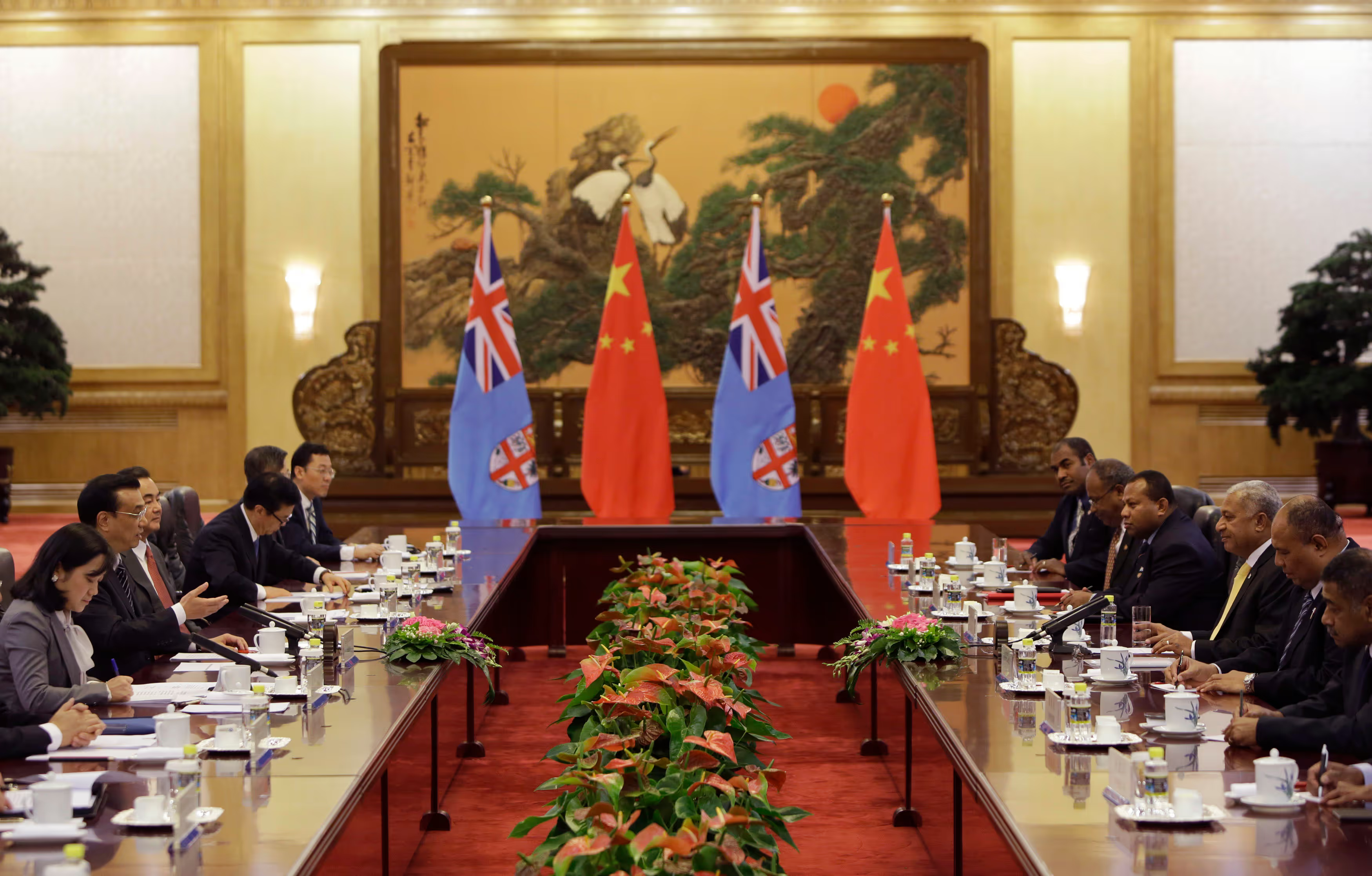
China’s foreign policy towards the island nations of the Southwest Pacific began as a relationship led by diplomacy and development finance. In the past decade or so, it has become a broader strategic posture in which policing cooperation plays a leading role. China’s underlying interests in the region haven’t changed, but the ways and means it uses to pursue them have become more ambitious, visible and sophisticated during Xi Jinping’s presidency.
3.2.2
Trends and analysis
China’s regional interests
China views the Pacific more through a strategic lens than an economic one. With country-specific exceptions—mostly in the resources sector—Pacific island countries (PICs) are of little economic importance to Beijing. Their collective GDP is less than one-third of 1% of China’s, and they absorb only a small fraction of China’s bilateral trade, outbound investment and development assistance. Relatively modest resource commitments on Beijing’s part can thus deliver outsized returns for its strategic goals.
In the long term, Beijing seeks something akin to a Sino-centric regional order. Getting from here to there has a few different practical requirements, which are where defence and security engagements enter the picture. Beijing is looking to complicate if not deny US and allied access to the Southwest Pacific. PRC strategists, drawing on the lessons of World War II, have long recognised the importance of PICs to American power projection in Asia. Their perceptions of maritime encirclement by the US have motivated efforts to build countervailing access and presence in PICs, although those efforts have come into clearer focus only in recent years. The immediate intent is to reduce or compromise the Pacific’s potential utility to US forces in the event of a major regional conflict.
Beijing is also looking to diplomatically isolate Taiwan and shore up international support for Beijing’s interpretation of ‘One China’, as well as its policy positions in multilateral forums more generally. This too has a long pedigree, and a more visible one in the public record. Through the 1990s and early 2000s, both China and Taiwan used development financing to compete for diplomatic recognition from PICs.
China’s investment footprint
As some states accrued considerable debt to China (Tonga is a notable example), concerns over its potential use to secure military access gained prominence from 2016 onwards. Australian anxieties were notably roused by the China-financed extension to Luganville Wharf in Vanuatu—a potentially dual-use asset completed in 2017 amid persistent, although unconfirmed (and strenuously denied) reports that Beijing was seeking to establish a military base there. The episode was one of several large capital investments by China—including an airport upgrade on Papua New Guinea’s Manus Island, which was completed in 2022, and apparently yet-to-commence projects such as a refurbishment of the World War II airfield on Kiribati’s Kanton Island proposed in 2021—with unclear economic rationale, and it marked something of a highwater mark in regional concerns about the strategic implications of China’s growing economic footprint in the Pacific.
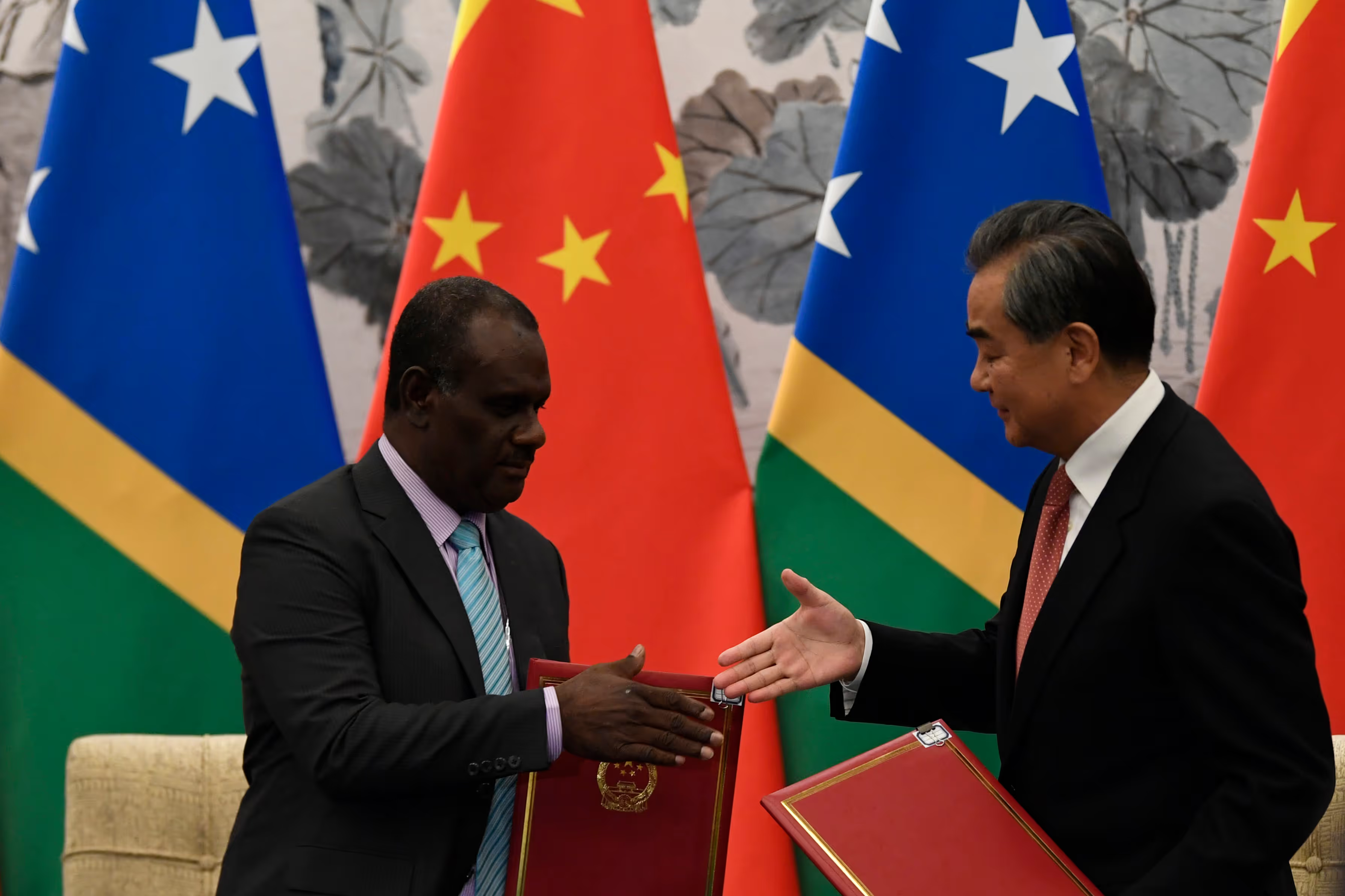
While anxieties over ‘debt-trap diplomacy’ generally weren’t borne out (China’s infrastructure loans are significant but only one of many structural risks to Pacific finances, and China’s development financing as a whole to the region peaked in 2016), development aid and security engagement remain visibly guided by strategic intent. In the past decade, China has recalibrated away from large and risky infrastructure loans to smaller, more cautious grant-led activities and budget support targeted at a select set of partners. The quid pro quo is often quite patent. Kiribati and Solomon Islands switched diplomatic recognition from Taiwan to China in 2019, and Nauru did so in 2024; millions in state-backed grants, loans, and infrastructure projects followed quickly.
The role of the PLA Navy
China has undertaken to regularise and normalise the presence of its military vessels in Pacific waters. Those efforts have until recently foregrounded soft power and non-combat force elements. Goodwill visits by PLAN hospital ships under the annual Harmonious Mission engagement and training ships such as the Qi Jiguang are characteristic of this approach.
Yuan Wang-class telemetry vessels have also made regular refuelling and resupply stops in Fiji and French Polynesia since the early 2010s to support the testing and evaluation of China’s space-based capabilities. Since an unusual and (so far) one-off ICBM test over Polynesia in 2024, regional access also has clear but limited relevance to China’s nuclear force modernisation.
Only in the past few years has hard power become a visible part of the PLA’s regional footprint. In late 2024, Vanuatu was visited by a PLAN destroyer and guided-missile frigate—the first deployment of such surface combatants to the Pacific. 2025 saw unprecedented PLAN live-fire drills in the Tasman Sea and the simultaneous passage of China’s two operational aircraft carriers beyond the First Island Chain.
The PLAN’s role in regional engagement remains largely demonstrative. Because only three regional states (Fiji, Tonga and Papua New Guinea) possess standing armed forces, the scope for direct military-to-military engagement is limited and in practice amounts mostly to donations of infrastructure and equipment. The donations have become sophisticated: the 2018 donation of a hydrographic vessel to the Republic of Fiji Navy, with crew training delivered by the PLAN, is indicative.
China’s embassies in Fiji and Papua New Guinea have also hosted military attachés since at least 2021, indicating the perceived utility of a specific and sustained diplomatic voice for the PLA in those countries. Those activities nonetheless remain modest in the broader context of China’s security engagement.
Policing cooperation at the centre
That broader context is one in which policing cooperation has taken centre-stage. Understandably so. With limited resources and, in many cases, chronic internal security problems, PICs have proven receptive to generous offers of police training, materiel and infrastructure from China. A 2011 police cooperation memorandum of understanding with Fiji, signed while the military government was in power, enabled short-term attachments by Chinese officers in Fiji and Fijian officer training in China. That agreement set the tone for future arrangements with other regional states.
Many Pacific police forces now train in China-built colleges (as in Samoa), operate China-donated vehicles and equipment, and work alongside Chinese police liaison teams (Solomon Islands, Kiribati and Vanuatu). The China–Pacific Island Training Centre at Fujian Police College, opened in 2024, is the latest highwater mark in capacity-building. There’s also an operational aspect to China’s engagement, which generally works through low-key, regular, embedded participation by China in ordinary community policing. Dramatic incidents like the joint Fiji-China arrests of 77 Chinese nationals in Nadi in 2017, and their return to China under police guard, set a high-profile precedent for extraterritorial enforcement, but are relatively uncommon.
This pattern of deepening and regularising police cooperation has had significant new institutional architecture built around it in the post-Covid-19 period. One pivotal year was 2022, when the Ministerial Dialogue on Police Capacity Building and Cooperation Between China and Pacific Island Countries, which has involved broad annual participation from across the region, was established. In the same year, China’s flagship Global Security Initiative (a new overarching policy framework for engagement, aligning China’s pursuit of its regional interests with a worldwide effort to export Chinese norms of public security practice) was announced.
While China’s bid for a region-wide multilateral ‘common development vision’ (including integrated security partnerships across multiple PICs) was rejected by Pacific states in 2022, key bilateral arrangements brokered around the same time continue to deliver results. Most notable here is the China–Solomon Islands security agreement (the full text of which remains undisclosed to the public) brokered in the wake of China’s provision of assistance to domestic security forces during the 2021 Honiara riots.
Here, at the vanguard of policing cooperation, hard-power strategy filters back in. The Solomon Islands deal, premised on Honiara’s internal security needs, is understood to contain wording that would allow PLAN warships to conduct ‘logistical replenishment’ in Solomon Islands subject to Honiara’s consent. Policing cooperation stands at the centre of an increasingly integrated approach to embedding China’s presence and access across the Pacific.