
For the Pacific, freedom of choice remains paramount. Beyond that, it’s hard to generalise. China’s deepening institutionalisation of security engagement has elicited many responses.
3.2.3
How is the Pacific responding?
Pacific responses
Kiribati, Vanuatu and Solomon Islands have drawn closer to China in some respects, but alignment is never unconditional; witness Kiribati’s sharp criticism of Beijing in the wake of its 2024 ICBM test over the Pacific. The May 2026 change of government in Solomon Islands, along with new Prime Minister Matthew Wale’s promises to review the 2022 security treaty with China, is another suggestion of fragility. While China is structurally embedded in Solomon Islands’ trade, infrastructure and security, alignment behaviour is also bound up in the prevailing leadership and factions of elite opinion.
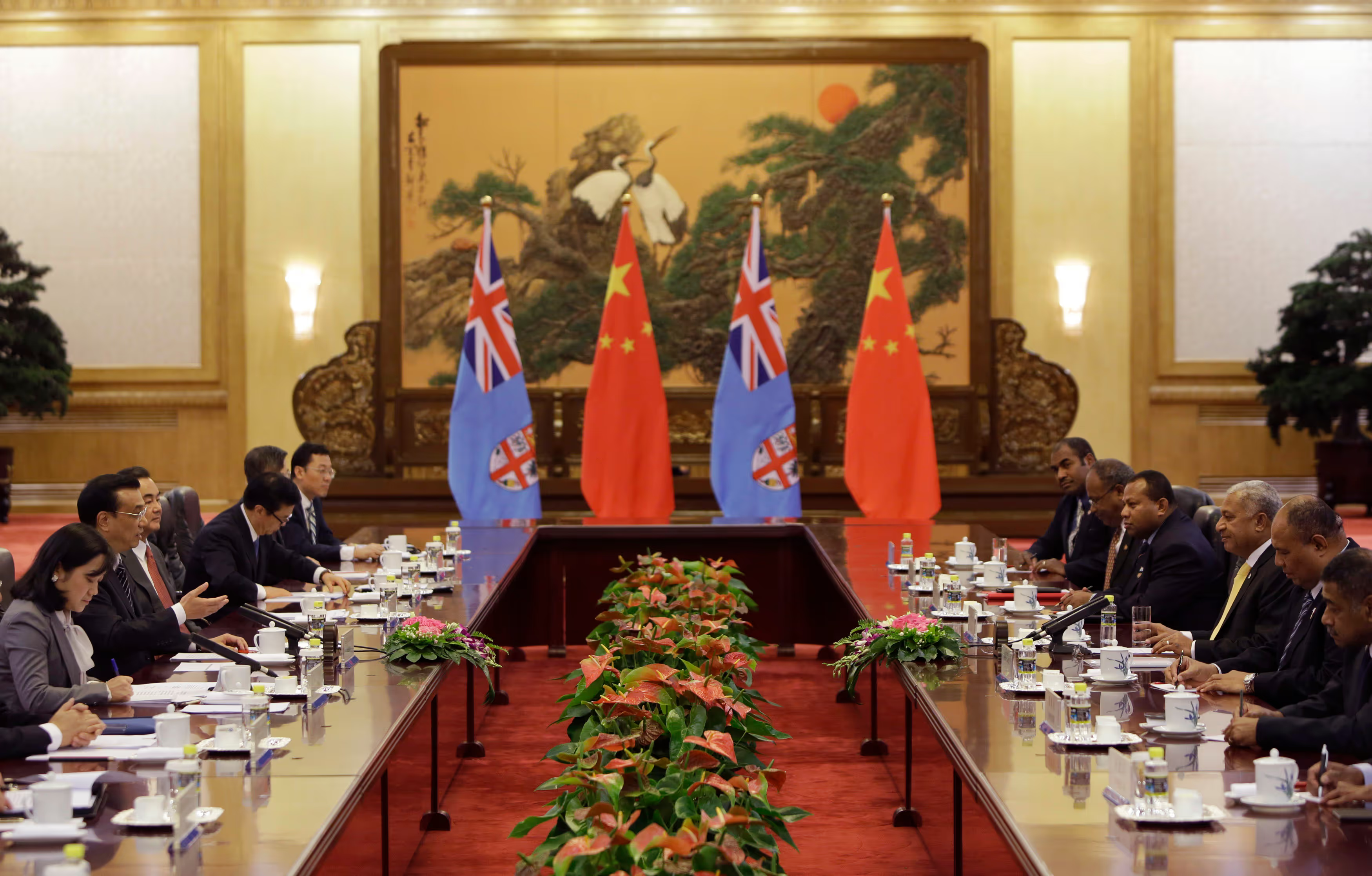
Fiji, which has hedged in the meantime, is a good example of that. Its closer security engagement with China was shaped partly by the post-2006 coup environment, when strained relations with Australia and other traditional partners encouraged Suva to diversify its external relationships. But unease about China’s reliability persisted within parts of the Fijian system, reinforced by enduring military and institutional links with Australia and other Western partners. Prime Minister Sitiveni Rabuka’s government reviewed Fiji’s longstanding police cooperation with China in 2023 and elected to keep some training links, while no longer permitting Chinese officers to be stationed inside the Fiji Police Force.
Tuvalu and Nauru, meanwhile, have accepted unusually strong Australian-backed security arrangements that narrow the scope for future engagement by China. The Australia–Tuvalu Falepili Union, signed in late 2023, combines climate cooperation, a migration pathway and a security guarantee, while requiring Tuvalu to mutually agree with Australia on any new security or defence partnership with another state. The Nauru–Australia Treaty, signed a year later (after Nauru’s diplomatic switch from Taiwan to China) similarly commits both sides to agree before any engagement in Nauru’s security, banking and telecommunications sectors.
'Permanent contest'?
Extra-regional efforts like this, which aim to ‘block’ further inroads by China through legal means, are characteristic of the condition of ‘permanent contest’ that Australian Foreign Minister Penny Wong has claimed now exists in the Pacific. Another characteristic is traditional partners’ efforts to match China’s engagement on its home ground. The Pacific-designed, Australian-funded Pacific Policing Initiative, spun up in 2024, presents a direct competitor to China’s policing cooperation activities.
Pacific states have no interest in letting their region become a theatre for the great games of great powers. Yet there are practical limits to what they can do about it, and the core challenge (or opportunity) they face is how to maximise the benefits of strategic competition while keeping that competition contained. For many PICs, the question has in the past been as simple as whether China’s engagement produced roads, stadiums, training, financing and diplomatic attention that traditional partners like Australia, New Zealand and the US hadn’t always provided. The step-change in political interest and resource commitment from those traditional partners since about 2016 has made the question far less simple.
